The Resale Condo Viewing That Costs The Most
Most buyers typically do viewings in the "reasonable" order - lobby, facilities, unit condition. Many buyers also check out the proximity to MRT and the buses route.
But the biggest regrets I see don’t come from missing a hairline crack or outdated tiles.
- They come from overlooking a quieter question:
Is this development actually a strong project within its district — or just a nice unit in a weaker performer?
Once you understand that, your viewings become calmer, clearer and far more decisive. You stop getting anchored by a renovation which I termed as "reno trap" .
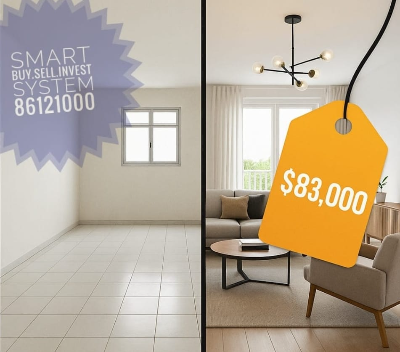
the " Reno Trap" - sleek reno appeared added value but in reality, buyers could pay more for style than substance
You start spotting which condos hold a better value, transact more reliably and are easier to exit when condition change.
Here's the viewing system I use - built for resale condos, designed to work even when listings are emotional, sellers are firm, and time is limited.
The X3010 Viewing System
- X hours pre-work (so you don't overpay for "nice")
- 30 minutes on-site before entering the unit (so you don’t miss livability signals)
- 10 minutes after (so you don’t rewrite red flags in your head)
Think of it as macro → project → unit.
Step 0: Shortlist smarter (before you even book viewings)
If you’re still scrolling listings, you’re already spending your most valuable resource: attention.
The goal isn’t “view more” which is again a common mentality with most buyers. The goal is view better—units that are reasonably priced and in projects that behave well over time.
Tool I use (by request): SG Undervalued Resale Condo Hunter
This helps surface potential mispricing and shortlist units that deserve a closer look—so your first viewing isn’t a random punt.
By request: message “SHORTLIST” for the prompt pack / checklist format.
Step 1: Future-proof the address (what’s coming next door matters)
Before you debate flooring or built-ins, you want to know what your future self is living with.
This step is about reducing “surprise friction”:
-
construction that wasn’t obvious during your first viewing
-
a future plot that blocks your view or increases noise
-
road changes that alter traffic flow
-
intensification that changes density and vibe
Fast checklist (Step 1)
-
What’s directly in front of the stack you’re considering (today and next)?
-
Any nearby sites likely to intensify (empty plots, low-rise pockets)?
-
Any persistent noise sources (main road curve, expressway exposure, school, industrial edges)?
-
How will the walk to transport feel in the rain or at night?
This step doesn’t need to be complicated. It just needs to be done before you get emotionally invested.
Step 2: Price context (district reality check, not listing - price storytelling)
Most buyers anchor on asking prices. That’s normal—and it’s exactly why Step 2 matters.
The point here is not “predicting prices.” It’s answering:
Is this asking price positioned sensibly relative to the surrounding market?
What I look for
-
3–5 closest comparable projects (similar age/tenure, similar amenity access)
-
price ranges that repeat (not just one lucky transaction)
-
whether the premium is defensible (MRT access, layout efficiency, low density, consistent stack premiums)
A project can be expensive for good reasons. The question is whether those reasons show up consistently—or only in sales pitches.
Tool I use (by request): Singapore Condo Resale Price Analyzer
This helps sanity-check whether the unit is fairly positioned versus realistic comparable and supports a rational “offer range” discussion.
By request: message “SANITY CHECK” for the prompt pack.
Step 2.5: The "cheap PSF" trap (lease + exit realism lens)
This is where buyers get misled by what looks like a bargain.
A lower PSF can be:
-
a genuine opportunity, or
-
the market quietly pricing in exit difficulty later (especially for certain age/lease profiles)
Tool I use (by request): Remaining Lease / Balance PSF Analyzer
It’s a fast check that helps you avoid paying “value pricing” for something the next buyer pool may discount. It helps buyer to figure out if an old Condo is worth its asking price.
By request: message “LEASE” for the lease-risk scan template.
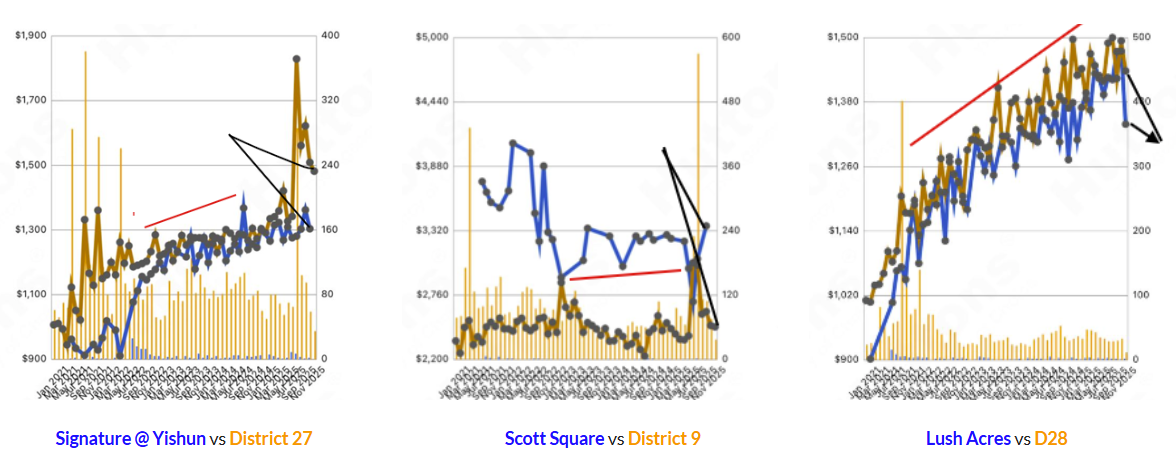
Step 3 (the one most buyers skip): Project vs District checkpoint.
This is where discerning buyers should slow down - because it prevents the most expensive kind of mistake" overpaying for a nice unit inside a weaker project.
Wait....some strong protesters please feel free to message me and share.
Step 3 is intentionally simple in concept (not simple in execution).
- 3 examples of benchmarking the project vs district.
- using Avg PSF trend (pricing power) and transaction volume trend (liquidity / exit-ability)
What Step 3 helps you answer
-
Is the project outperforming / tracking / lagging its district?
Is price movement supported by healthy volume, or driven by a few deals?
Which project may find buyer asking the question "Am I paying too much compared to similar other projects in the same district/vicinity?
By request (lead-gen): I keep this as a one-page Step 3 Factsheet + viewer scoring grid.
Message “FACTSHEET” and I’ll share the template.
(For obvious reasons, I don’t publish the full Step 3 framework in the article—it’s the exact checklist I use to filter projects quickly and objectively.)
Step 4: Walk the neighborhood (the map is not the lived experience)
Now we go on the ground—before the unit.
Do the walk that you’ll actually live:
-
MRT/bus stop route (try both day and evening if possible)
-
sheltered segments (rain matters in Singapore)
-
crossings and junction friction (you’ll feel it daily)
-
noise pockets (stand still for 2 minutes and listen)
This step is a reality check: the best unit in a location you don’t enjoy becomes a lifestyle tax.
Step 5: Development walk-through (signals of management and livability)
Before you enter the unit, observe the project as a whole:
- does it feel crowded at peak hour?
-
are lifts a bottleneck?
- are the corridors strewn with junk?
-
are facilities maintained like an asset?
- are there pending lawsuits?
- is security real, or performative?
- more (that most buyers overlooked)
Small “maintenance tells” are often more honest than brochures.
Step 6: Unit walkthrough (objective checks first, aesthetics last)
1) Condition & water risk
-
check wet areas, ceilings, corners, and under-sink cabinets
-
watch for musty smell, stains, bubbling paint, hairline cracks that repeat
2) Heat / sun / ventilation
-
is it west sun harsh?
-
is airflow workable with windows open?
-
does it feel stuffy even during the day?
3) Layout efficiency
Just to name a few..
-
can bedrooms fit real beds with walking space?
-
is there “wasted corridor tax”?
-
is the living/dining usable without strange angles? i.e Oddshape?
Then—and only then—consider renovation. Renovation is the easiest part to change. The fundamentals are not.
Before you offer: affordability + CPF readiness
Even if the unit and project are great, the purchase should still feel comfortable, not just possible. There are no guess work!
Tool I use (by request): Condo & HDB Resale CPF Advisor (Private)
Useful for buyers who want to sanity-check CPF usage and household affordability constraints before committing.
By request: message “CPF” for the prompt pack.
If you want resale viewings to feel less emotional and more decisive, keep the order: macro → project → unit.
And if you’d like my buyer toolkit (by request):
-
“SHORTLIST” — undervalued shortlist prompts (should you even shortlist to view - ok if you have too much time on your hand:)
-
“SANITY CHECK” — resale price sanity check (are you over-paying)
-
“LEASE” — lease vs PSF quick scan (how to tell if an old condo is worth the asking price)
-
“FACTSHEET” — Step 3 one-page Project vs District Factsheet + scoring grid (Like it or not, how does the condo of interest compare to other condos in the same district)
-
“CPF” — affordability/CPF prompts (start on the right note - TDSR, LTV)