|
District |
Overall (%) |
|---|---|
|
28 |
3.82 |
|
27 |
3,59 |
|
14 |
3.59 |
|
25 |
3.54 |
|
6 |
3.51 |
|
3 |
3.49 |
|
19 |
3.43 |
|
13 |
3.41 |
|
8 |
3.35 |
|
22 |
3,30 |
Buying a Condo In Singapore, But Can't Decide Between A Freehold Or Leasehold?
If you're buying a condo or apartment in 2026 - whether it's your first resale purchase, your first new launch or your HDB upgrading "big move" - the freehold vs leasehold question will often show up early and then quietly influence almost every decision after: budget, location, unit size, exit plan and even how much CPF you can safety rely on later.
So which is better: Buying a Freehold or Leasehold?
First thing first, before we answer, when potential buyers said “Better”, what do they mean exactly?
Is it the profits, prestige, concerns over lease decay, unwilling to live near someone (mother-in-law) or legacy reasons?
Different buyers buy for different reasons. To me, there are no rights or wrong. Indeed, there are many reasons for choosing FH over a leasehold. This article focuses on the profit aspects.
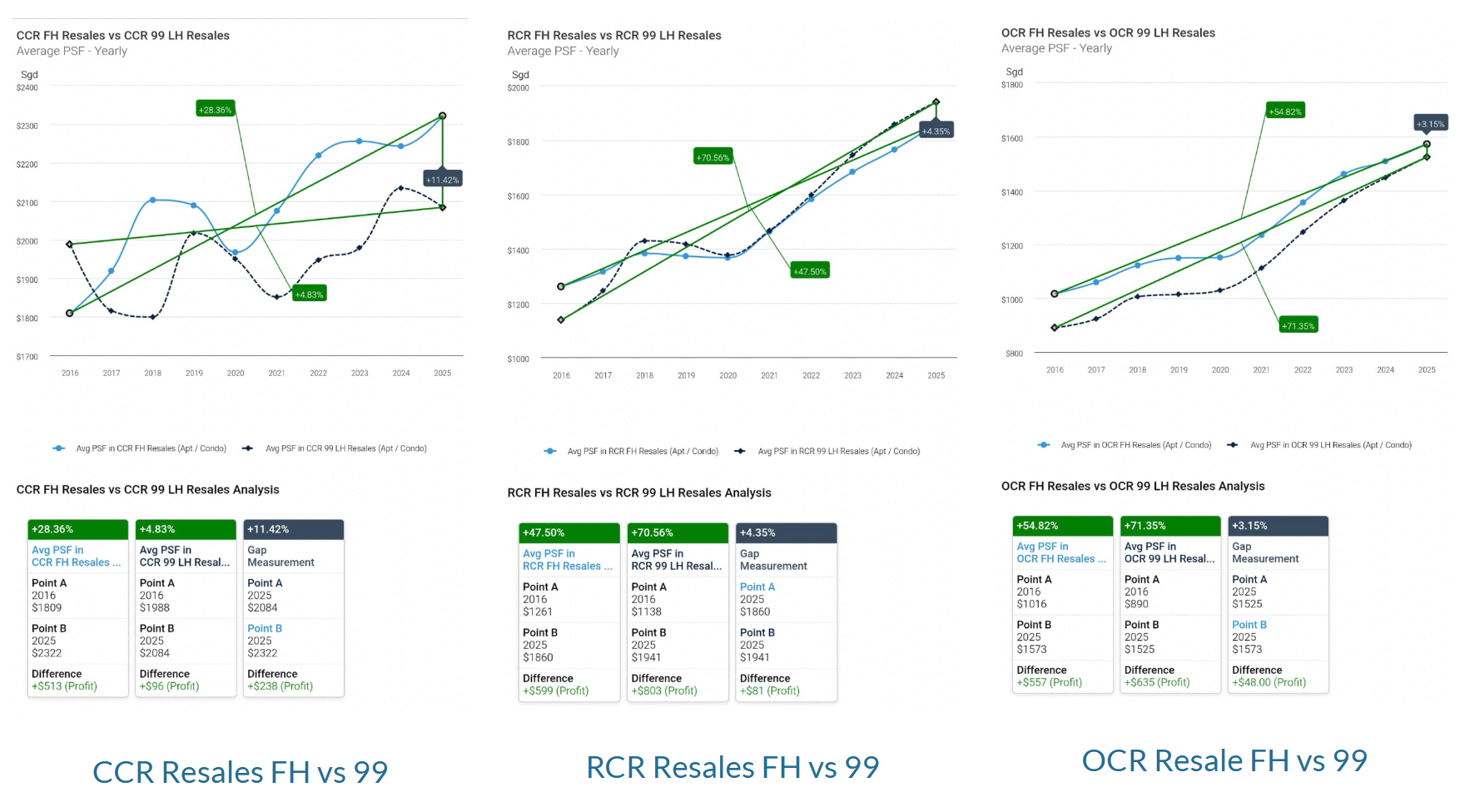
Here’s the twist: “Freehold is always better” isn’t supported cleanly by real-world performance. A large transaction-based comparison (2016–2024) found that leasehold often matched or beat freehold on percentage returns, especially for new launches, while freehold more often won on absolute dollar gains (because it starts from a higher base).
So instead of asking “Which tenure is best?”, a more useful 2026 question is:
“Am I paying a premium that I can realistically earn back—given my holding period and exit buyer pool?”
Let’s build that answer in a way that works for:
first-time condo buyers (resale or new launch),
seasoned investors,
HDB upgraders,
and anyone choosing between 99-year / 999-year / freehold,
The 2026 reality check: what the long run data suggests (and what it doesn't)
A transaction study spanning 2016 - 2025 compared freehold (including 999-year treated as freehold) vs leasehold condos across sizes and purchase types. It found:
Across all transactions (new + resale mixed): leasehold slightly outperformed freehold on percentage returns in several size bands (1BR,2br,3BR,4BR,%BR); freehold often had higher absolute gains.
For new launches specifically: leasehold outperformed freehold across every size category on ROI/annualized returns in that dataset—most dramatically in smaller units.
For resale-only: the gap shrinks a lot—suggesting tenure matters less once price discovery has already happened.
By market segment: location/affordability drove outcomes more than tenure. Leasehold in OCR (mass market) showed strong annualized returns; leasehold in CCR looked weak in that sample (high base prices + “contrast effect” when surrounded by freehold).
So does it mean leasehold is always better?
No, It doesn’t. Tenure is usually a tiebreaker, not the main engine. The main drivers are still entry price, location, buyer demand, and supply pipeline—and tenure affects those indirectly.
The premium problem: the only question that really matters
Both major consumer guides and market commentary repeatedly point to a reality most buyers feel immediately:
Freehold typically costs more than a comparable leasehold unit in the same area. One guide pegs that at around ~15% in like-for-like comparisons, while another uses a “rule of thumb” range of ~10–15%.
Now premium is not automatically “bad.” It’s only bad if:
you don’t need it for your holding period, and
you can’t realistically earn it back (or it compresses your cashflow too much).
A simple “premium payback” test (use this in 2026)
Assume two similar condos in the same neighborhood:
Leasehold price: $1,500,000
Freehold price (15% premium): $1,725,000
Premium paid: $225,000
Now ask:
Will a tenant pay more rent because it’s freehold? Usually no—tenure rarely changes rent by itself.
Will a future buyer pay $225k more because it’s freehold? Maybe—but only if they’re also willing to pay that premium in that future market, and only if the project still looks compelling against newer supply.
If you’re an investor, you can also sanity-check using yield:
- If both rent at, say, $4,500/month (=$54,000/year):
Leasehold gross yield ≈ $54,000 ÷ $1,500,000 = 3.6%
Freehold gross yield ≈ $54,000 ÷ $1,725,000 = 3.1%
This mirrors the exact “math reality” argument: (click to see 5 years average rental yield for the top ten districts) lower entry price often gives better yield, because rent doesn’t “care” about tenure.
So in 2026, freehold isn’t about “better.” It’s about whether you can afford to be patient enough for the premium to make sense.
CPF rule you should know (this affects resale strategy)
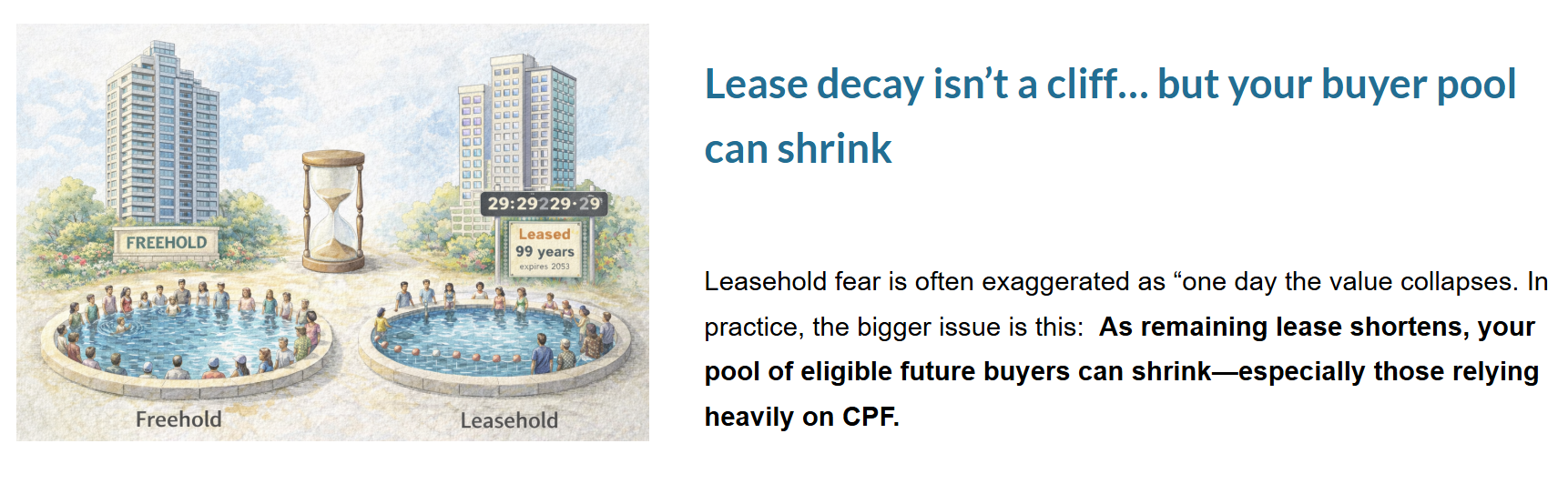
CPF Board guidance states: If the property's remaining lease can last the youngest buyer to age 95, CPF usage can up to the lower of price/valuation. If it cannot cover the youngest buyer to 95, CPF usage beceomes pro-rated (and capped) This is why two leasehold condos can bheave very idfferently on resale: a "younger" 99 year laeasehold often sells like any other mass market condo whereas an older leasehold with a much shorter remaining lease may face more friction because buyers have to bring more cash//loan and less CPF funds.
Practical 2026 takeaway. If you're buying resale leasehold, don't just look at "99-year". Look at remaining lease +likely buyer age profile when you sell.
New launch vs resale: why leasehold looked “surprisingly” strong
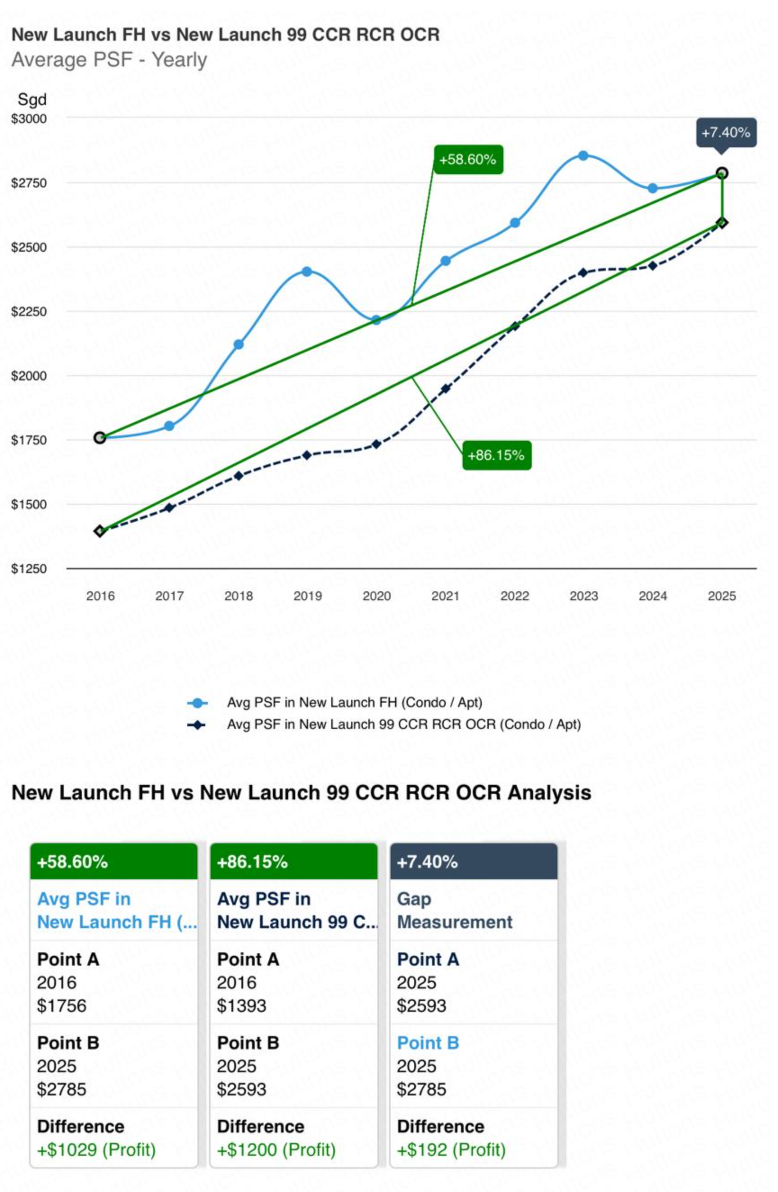
That 2016 - 2025 dataset showed a notable pattern:
New launch leasehold beat new launch freehold across all sizes in ROI/annualised returns.
Why might that happen?Many new launches are in mass-market / fringe regions where leasehold dominates and the base price is lower, leaving more room for upside.
Freehold supply skews toward boutique or higher-entry-price projects, which can compress percentage returns.
Then when you look at resale-only transactions, the tenure gap becomes much smaller.
That’s an important 2026 insight:
If you’re choosing a resale home, tenure matters less than whether you’re buying “right” (location, layout, competition, entry price).
If you’re choosing a new launch, your entry price vs surrounding resale becomes even more crucial—and tenure premium can be harder to justify.
Freehold myths worth retiring (before you overpay)
Myth 1: “Freehold can’t be taken back”
Even if you buy freehold, land can still be acquired for public purposes; compensation is based on market value under the Land Acquisition Act framework, administered by SLA. (Singapore Land Authority)
So freehold is not a “never move” guarantee. It’s more like a stronger title, not an unbreakable promise.
Myth 2: “Freehold can’t go en-bloc”
Freehold projects can still go en-bloc if the required majority agrees; your tenure doesn’t immunise you from collective sale outcomes.
Myth 3: “Freehold always outperforms”
The performance data doesn’t support a blanket statement. In the 2016–2025 comparison, leasehold often led on annualised percentage returns, especially for new launches; outcomes varied by unit type and segment.
A clean 2026 decision framework (works for buyers + investors)
Use these 7 steps to decide without getting emotionally anchored to tenure.
1) Decide your holding period (and be honest)
3–5 years: you’re mostly playing market cycle + entry price + project competitiveness. Tenure is rarely the main driver.
7–12 years: you need a credible resale buyer pool when you exit. Leasehold is often fine—if remaining lease is healthy.
15+ years / legacy intent: freehold/999 can make sense—but only if you’re not sacrificing location and liveability.
2) Run the “premium payback” in dollars, not vibes
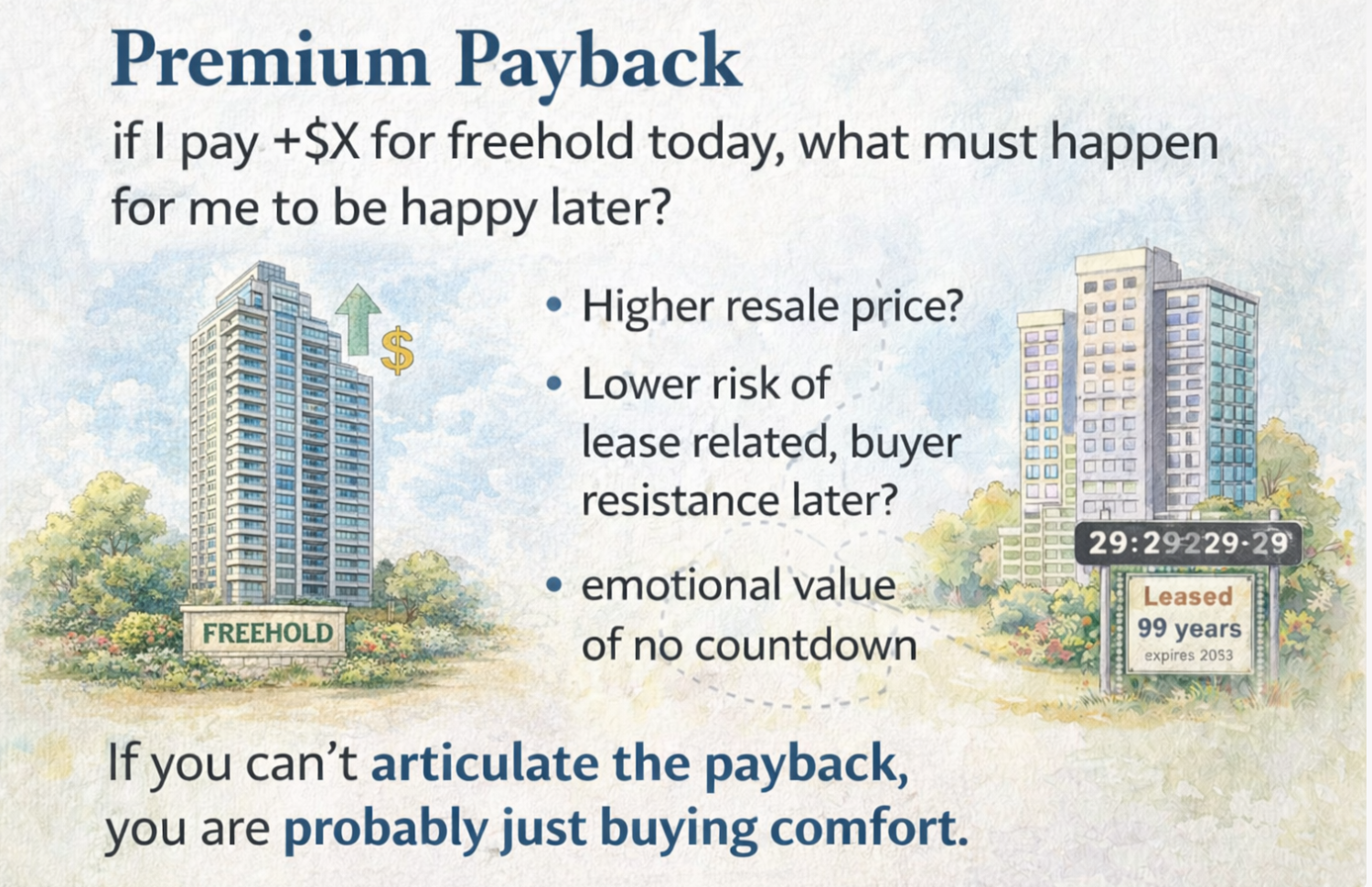
Ask: “If I pay +$X for freehold today, what must happen for me to be happy later?”
Higher resale price?
Lower risk of lease-related buyer resistance later?
Emotional value of ‘no countdown’?
If you can’t articulate the payback, you’re probably just buying comfort.
3) Compare like-for-like, not brochure-to-brochure
For any shortlist:
same neighbourhood (or same MRT catchment),
similar age (new vs new, resale vs resale),
similar unit size and facing,
similar facilities and maintenance.
Otherwise, you’ll mistakenly attribute “location and project quality” to “tenure.”
4) For resale leasehold, check the CPF/age-95 factor early
If your eventual buyer likely relies on CPF, shorter remaining lease can reduce CPF usability (pro-rated). (Central Provident Fund)
This doesn’t kill value—it changes the buyer pool (more cash-heavy buyers, fewer first-timers).
5) For new launches, don’t ignore the data pattern
In the 2016–2025 comparison, new launch leasehold units outperformed new launch freehold in ROI/annualised returns across sizes.
Treat that as a warning against overpaying for “freehold new launch” unless the fundamentals are exceptional.
6) En-bloc is a bonus, not a plan
Both tenure types can go en-bloc; outcomes depend on market conditions, zoning, and what developers can rebuild.
If you need en-bloc for your return to work, it’s not an investment thesis—it’s a hope.
7) Write your exit story in one paragraph
Before you buy, you should be able to say:
“I’m buying this unit because these buyers will want it in X years, for these reasons, and my worst-case exit is Y.”
If you can’t write it, you’re not ready to choose between FH vs LH—you’re still choosing between ideas.
Three buyer profiles (illustrative) and what usually fits
Profile A: HDB upgrader family, 7–10 year horizon
Often does well with:
a strong leasehold mass-market project near transport/schools,
prioritising layout, usability, and resale demand.
Why: your resale buyer pool in 7–10 years is likely still broad, and the opportunity cost of paying a big freehold premium can be high.
Profile B: New launch buyer trying to balance risk + upside
Often does well with:
leasehold new launches that are competitively priced vs nearby resale,
avoiding “freehold premium” unless it comes with genuinely superior scarcity or location.
Why: the dataset shows new launch leasehold performed strongly over that period, suggesting entry price and mass-market liquidity can matter more than tenure.
Profile C: Long-stay / legacy-minded buyer (15–25 years)
Often does well with:
freehold/999-year if the premium is reasonable and the home actually fits life plans,
or a well-located leasehold where the “home utility” is so strong you’d live there regardless.
Why: the value of “no countdown” is most meaningful when you actually intend to hold very long—otherwise you’re paying for a feature you won’t use.
Top 10 Average Rental Yield For All Bands 5 Years (Source: URA)
Readers who are keen to understand the yield play...
- do average yields vary across different Singapore districts and unit sizes.
- which specific propety sizes consistently generate the highest rental yields across most districts?
- What geographic trends emerge when comparing rental yeild data acrsoss the various dsitricts?
Can requrest insighest here